
About the Van Allen Probes Mission
 |
|
|---|---|
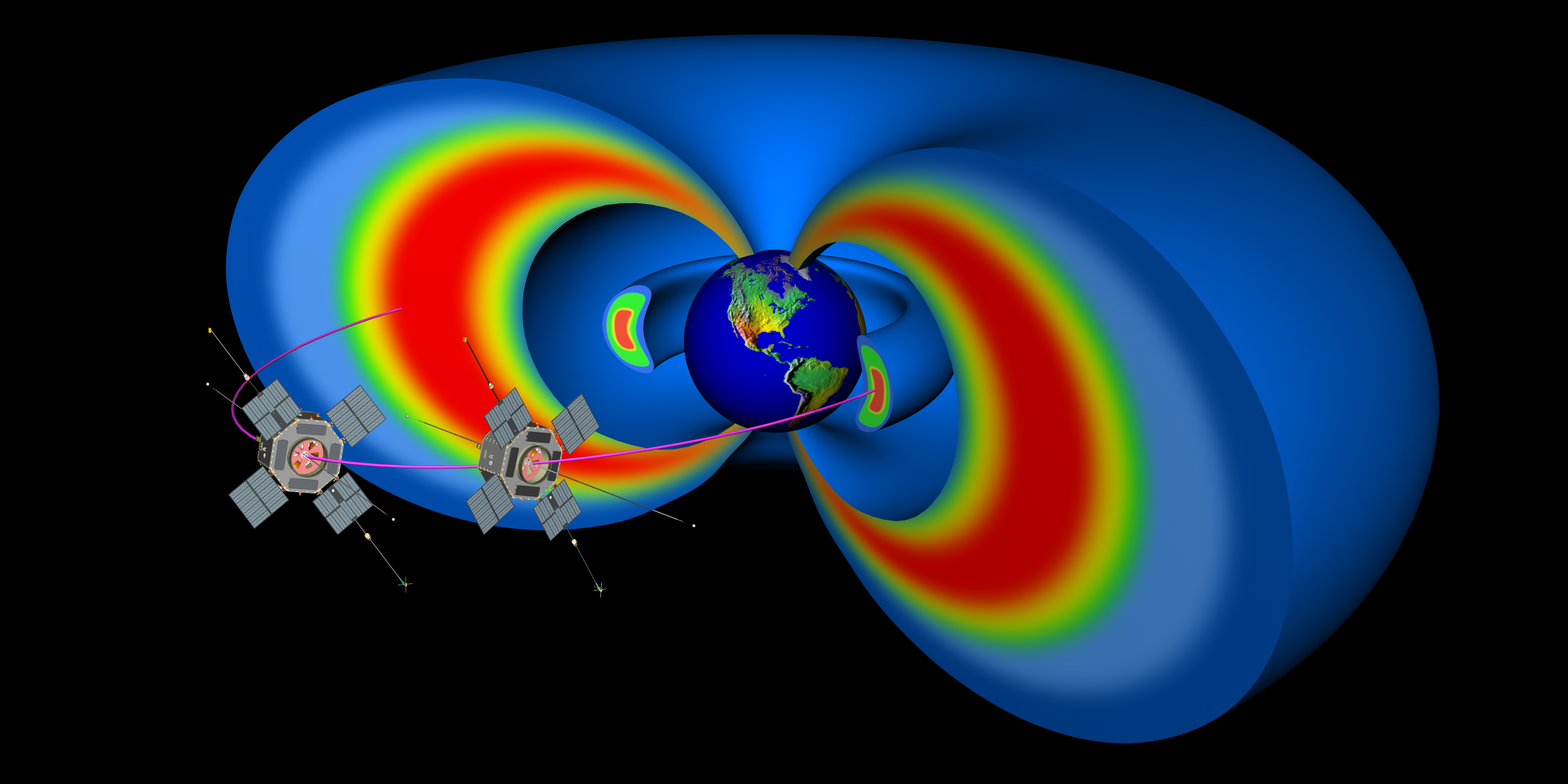
| Artist's rendering of the radiation belts with RBSP spacecraft |
|
The Van Allen Probes mission, initially named the Radiation Belt Storm Probes mission, or RBSP, was designed to help us understand the sun's influence on Earth and near-Earth space by studying the Earth's radiation belts on various scales of space and time. The radiation belts, discovered by astrophysicist James Van Allen, are a toroidal-shaped region of the magnetosphere where energetic electrons and ions are held in place by magnetic fields. This is an area of intense space weather, causing serious safety risks to astronauts and spacecraft.
Most satellites orbit through the radiation belts, and even the International Space Station orbit skims the radiation belts. While space missions typically avoid this region, the twin Radiation Belt Storm Probes will spend all of their time there. The RBSP satellites will quantify the processes that generate the radiation belts and cause them to change.
The Applied Physics Laboratory built and will operate the twin RBSP spacecraft, or "probes." In order to observe changes in the radiation belts through both space and time, each probe carries an identical suite of science instruments.
ECT on RBSP
Each probe's science payload has five instruments:
- Energetic Particle, Composition, and Thermal Plasma Suite (ECT)
- Electric and Magnetic Field Instrument Suite and Integrated Science (EMFISIS)
- Electric Field and Waves Suite (EFW)
- Radiation Belt Storm Probes Ion Composition Experiment (RBSPICE)
- Relativistic Proton Spectrometer (RPS)
These instruments provide measurements needed to characterize and quantify the processes that produce the relativistic ions and electrons in the radiation belts. They measure the properties of these charged particles, the plasma waves that interact with them, the large-scale electric fields that transport them, and the magnetic field that guides them.